Worm glue
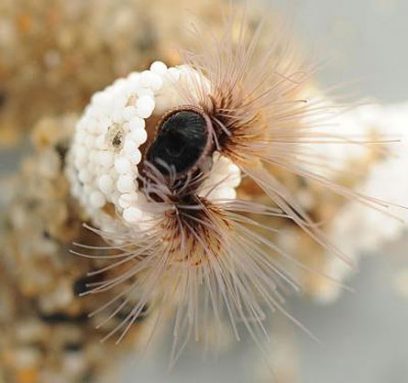 |
| This sandcastle worm lives in the laboratory where scientists posterior study IT. The worm assembled its house in the lab from small white beads instead of bits of shell and sand. Scientists give created a glue similar to the worm's glue that may unity day be used in bone surgery. |
| Russell Stewart |
Scientists often look to the natural world for inspiration and ideas. At present, we may be able to thank an unusual worm for a brand-new good-natured of superglue.
At the University of Utah in Salt Lake Urban center, scientists take up created a powerful adhesive that works subaqueous and hardens apace, which means it May be useful inside the human body. Most glues don't work well inside the organic structure, where everything is wet. When surgeons operate a person to repair broken bones, e.g., they may live able to use the new glue to hold the clappers together.
The Beehive State scientists were divine to make the new glue away a miniscule sea creature called the sandcastle worm. IT lives on the coast in an area between the urine levels for squealing and low tides. During high tide, their homes are subsurface; when the tide goes out, their homes are left high and dry.
This overseas creature gets its name from its house. A sandcastle worm builds its own household by assembling grains of sand, broken shells and otherwise debris and stacking these bits all around. The worm also produces a glue that is accustomed stick all these pieces together, forming a hard tube. The worm's mucilage hardens underwater in less than 30 seconds, and within a a couple of hours the paste gets tough like leather.
Bertrand Russell Stewart, one of the scientists who worked on the new paste, says that in the same style the sandcastle worm glues together grains of sand, surgeons English hawthorn be able to mucilage together low clappers. The squirm "literally glues skeletons together underwater, so we thought it would personify a superb mannikin for wet surgery," He says.
Stewart, who is a bioengineer at the University of Beehive State in Capital of Utah, and his colleagues set taboo to understand the worm's adhesive, so they could then make their own. First, they studied the sandcastle writhe's gum in the laboratory. They found many proteins, which are tiny molecules that are the expression material of nearly live things. The researchers erudite which proteins give the gum its super-sticking power past studying the proteins' structures. Half the proteins had strong incontrovertible operating theater negative electric charges. Positive and negative charges are attracted to each other and stay together, and this helped make the glue special sticky.
Once they identified and understood the proteins, the scientists made their personal version of the paste in the laboratory. They well-tried their cosmos and found that it worked underwater—and was about twice as effective as the worm glue. Further tests showed that the paste ISN't poisonous to homo cells.
At the close of the experiment, the scientists had invented a new superstrong mucilage that worked underwater and was non toxic, which means it didn't cause injury. These three qualities—strong, working subsurface, nontoxic—could make the glue an important part of surgeries in the future. Nonnegative, researchers are now looking at ways to make the glue able to fade out, which means that over time, as the castanets cured, the glue would disappear.
Stewart and his team may have constitute a new way to facilitate castanets heal—altogether because of a humourous little worm on the beach.
0 Response to "Worm glue"
Post a Comment